Quick answer:
A cleaning-related bond claim can arise when a rental property is not left reasonably clean compared with its condition at the beginning of the tenancy. In NSW, fair wear and tear also needs to be considered, so not every mark, stain or sign of use automatically justifies a cleaning claim.
For Sydney renters, the final inspection can bring attention to cleaning issues that were easy to overlook during everyday living. Grease in the kitchen, bathroom residue, carpet stains, dusty skirting boards, dirty window tracks and debris inside cupboards are common areas worth checking before handover.
The best approach is to compare the property with its entry condition, work through each room systematically and deal with overlooked areas before returning the keys.
What makes a cleaning issue relevant to a bond claim?
NSW tenants are expected to keep the rental property reasonably clean and return it in a condition that takes its starting condition into account, allowing for fair wear and tear.
Your entry condition report is particularly useful because it records the property’s condition when the tenancy began. Comparing it with the property at the end of the tenancy can help identify what needs cleaning and what may simply be normal deterioration.
This distinction matters. A tenant should not assume that every mark, stain or sign of use is a cleaning issue, just as a landlord or agent should not automatically treat every change as tenant-caused damage.
With that in mind, here are the cleaning areas worth checking before a Sydney rental reaches its final inspection.
Kitchen cleaning issues that are easy to miss
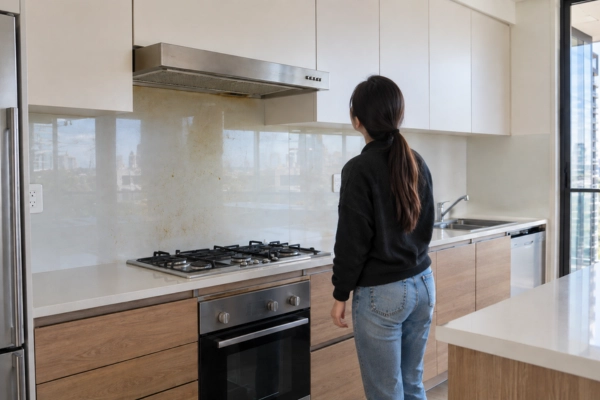
The kitchen can accumulate grease, food residue and grime gradually. Some areas may look clean during everyday use but become much more noticeable once the property is empty.
Grease on splashbacks, cupboards and rangehoods
Cooking vapours can leave a layer of grease on splashbacks, cupboard doors, handles and rangehood surfaces.
Pay particular attention to:
- Rangehood surfaces and accessible filters
- Splashbacks
- Cupboard doors and handles
- Cabinet edges and tops
- Areas beside cooking appliances
- Grease around the cooktop
A thorough clean should deal with more than the surfaces that are immediately visible when you walk into the kitchen.
Oven and cooktop residue
An oven can appear clean from the outside while still having baked-on food, grease or spills inside.
Check the oven cavity, racks, trays and door glass, along with the cooktop and surrounding surfaces.
If the property was reasonably clean when you moved in, accumulated cooking residue is worth addressing before handover rather than leaving it for the final inspection to identify.
Dirt around sinks, taps and benchtop edges
Small areas around kitchen sinks can collect food residue, grime and mineral deposits.
Check around taps, sink edges, joins, splashbacks and the edges of benchtops. These areas are easy to miss when cleaning quickly because they take up very little space.
Bathroom and living area problems that show during inspection
Bathrooms and living areas can develop different cleaning problems during a tenancy. Once furniture and personal belongings are removed, accumulated dirt can also become easier to see.
Soap scum and built-up bathroom residue
Shower screens, tiles, taps and bathroom fittings can develop soap scum and mineral deposits over time.
Check:
- Shower screens
- Wall and floor tiles
- Tapware
- Shower fittings
- Vanity edges
- Basin areas
- Floor edges and corners
A quick wipe may not remove residue that has built up over a longer tenancy.
Mould and grime in damp areas
Damp areas deserve particular attention, especially around bathrooms and laundries.
However, mould should not automatically be treated as a tenant cleaning issue. The cause matters. Poor ventilation, leaks, water intrusion and other property-related problems can require action from the landlord or agent.
If you find significant mould or an underlying moisture problem, report it rather than assuming that cleaning alone will solve it.
Dust and dirt on skirting boards, doors and fixtures
Once furniture is removed, areas that have been hidden for months can become obvious.
Check skirting boards, door frames, doors, light fittings, switches, vents and other fixtures for accumulated dust and grime.
These details are easy to overlook if your cleaning focuses only on floors, benches and other large surfaces.
Carpet stains and embedded dirt
Carpets can accumulate dust, dirt and stains, particularly in high-traffic areas.
Before handover, inspect:
- Hallways
- Living areas
- Entryways
- Bedrooms
- Stairways
- Areas underneath furniture
- Carpet edges and corners
If stains or embedded dirt remain after normal cleaning, professional carpet steam cleaning may be worth considering, particularly for high-traffic areas.
Often-overlooked areas around the property
Some cleaning problems are not found in the main rooms. They are often hiding in storage spaces, window tracks and other areas that receive less attention during routine household cleaning.
Window glass, frames and tracks
Windows can collect dust, dirt, cobwebs and debris around the glass, frames and tracks.
Check both the visible glass and surrounding areas. Window tracks can be particularly easy to miss because dirt often collects in narrow sections that are not obvious from across the room.
Cupboard interiors and storage areas
Empty cupboards can reveal crumbs, dust, hair and other debris that were hidden while belongings were stored inside.
Check kitchen cupboards, bathroom storage, wardrobes and other built-in storage areas included with the rental.
Look at shelves, corners, edges and internal surfaces rather than simply checking that everything has been removed.
Balconies, garages and other included areas
The cleaning job may extend beyond the main living areas.
Depending on the property and tenancy agreement, balconies, garages, laundries, storage spaces and other included areas may also need attention.
Remove rubbish, sweep accumulated dirt and check corners and other areas where debris can collect.
Pet hair and accumulated debris
Pet hair can collect in carpets, corners, underneath furniture and along skirting boards.
If you have had an approved pet at the property, check these areas carefully before handover. A standard vacuum may not always remove embedded pet hair from carpet effectively.
How to reduce cleaning-related bond problems before handover
A final clean is easier when you approach it as an inspection rather than simply doing your usual household cleaning.
1. Start with the entry condition report
Your condition report is one of the most useful references when preparing to leave.
Compare each room with the report and any photographs you took when you moved in. This gives you a practical reference for identifying areas that need attention before handover.
2. Use a room-by-room inspection checklist
Do not rely on memory.
Work through the property systematically and check floors, walls, surfaces, fixtures, storage areas, windows and other relevant areas.
A checklist can also stop you from finishing the kitchen and bathroom while forgetting the laundry, balcony, garage or cupboard interiors.
3. Check at eye level, above and below
Cleaning is often done from the perspective of standing in the middle of a room.
Before you finish, look underneath benches, around skirting boards, behind doors, inside cupboards and around appliance edges. Also check accessible higher surfaces such as rangehoods and light fittings.
4. Allow enough time before handover
Trying to clean an entire property the night before the final inspection can create unnecessary pressure.
Start early enough to deal with areas that need extra attention. If the property has extensive carpet, multiple bathrooms, large windows or several outdoor areas, allow additional time.
This also gives you an opportunity to arrange specialist cleaning if needed.
5. Consider professional end of lease cleaning when the job is beyond DIY cleaning
Professional end of lease cleaning can be useful when the property requires more time, equipment or detailed attention than you can reasonably provide yourself.
A Sydney rental with multiple bathrooms, extensive carpet, a heavily used kitchen, large windows or several included outdoor areas can take considerably longer to prepare than a typical household clean.
The goal is not simply to make the property look tidy. It is to return it thoroughly cleaned and ready for the final inspection, consistent with the property’s starting condition and applicable tenancy requirements.
What if cleaning costs are claimed from your bond?
A cleaning-related bond claim is not automatically the same as a confirmed deduction.
If a landlord or agent makes a claim that you disagree with, NSW Fair Trading recommends trying to resolve the issue with them first. If the matter cannot be resolved, there are formal dispute processes available for residential rental bonds.
Keep your entry condition report, photographs and relevant tenancy records. They can help establish the property’s condition at the beginning and end of the tenancy if a dispute arises.
Final thoughts
The easiest way to reduce cleaning-related bond problems is to prepare for the final inspection rather than simply doing a last-minute tidy-up.
Start with the property’s entry condition, work through every room and check the areas that are easy to overlook. Kitchen grease, bathroom residue, carpet stains, dusty fixtures, dirty window tracks, cupboard debris and pet hair are all worth checking before handover.
If your move-out deadline is approaching and the property needs a detailed clean, End of Lease Cleaning Experts Australia can help prepare your rental for final inspection. Our Sydney Cleaners are well-trained, insured and police checked for your peace of mind.
Request your online quote and ask about same-day availability if your handover deadline is approaching.